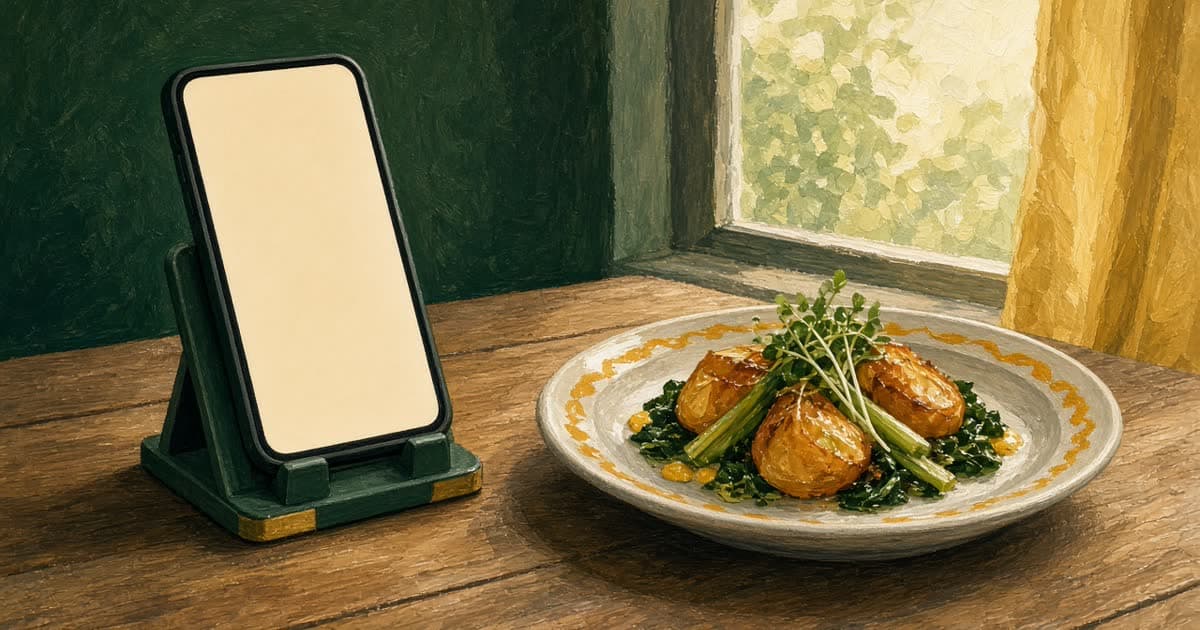
You can get food photos without a photographer. A small restaurant needs a handful of honest pictures of the plates it serves, not a portfolio and not a shoot every week. Three routes cover almost everyone: your phone by a window, one borrowed afternoon for a set that matches, and a picture made from the menu line for the dishes you have not had time to shoot.
The test for all three is the same. Would a regular recognise the plate? If the picture promises a taller stack, a different garnish or a gloss the kitchen does not produce, it is the wrong picture, however pretty it is.
You need a small set, not a library
Five dishes you actually sell, one photo of the outside, one of the room. That is a working set for months. You do not need every garnish, every cocktail and every angle. Start with the plates people order, because those are the posts you will make on a Wednesday when you have four minutes.
Shoot the outside on an ordinary day, not only on the day the flowers arrive. Shoot the room as it is, with the chairs you own. People deciding where to eat are trying to imagine sitting down. These two pictures also give you something to post that is not food, which helps the posts about hours, the door and how to find you.
Your phone, by the window
Daylight from a window is the whole trick. Overhead lamps turn sauces grey or orange. The flash on the phone turns them into plastic and throws a shadow of your hand onto the plate. Turn the flash off. Stand so the window is to the side or slightly in front of the dish, not behind it.
A reliable way to do one dish, in the gap between prep and service:
- Use a plate, bowl or board you actually serve on. A borrowed prop reads as a different restaurant.
- Put one dish in the frame. Move the salt, the receipt, the spare glass and the cloth out of the way.
- Wipe the rim. A smear is the first thing a person sees, and it is the easiest thing to fix before the photo rather than after.
- Hold the phone slightly above the plate, not so close that the near edge bends. If you are unsure, take one from above and one from the angle a guest sees.
- Take ten. Keep one. Look at the keeper large, on the phone, before you post it. Most problems only show up then.
- If the colour of the sauce is wrong, do not push it in an editor until the picture lies. A dull true photo beats a bright false one.
Steam, a pour, or a hand in the frame is hard to do well on a phone in a hurry. Skip the action. A still plate in good light is the professional-looking result, because it is calm and it is true.
Crop square if you are posting to a feed that uses squares, but shoot a little wider than you need so you can crop later without cutting off the rim. Leave the restaurant's name out of the plate. The caption and the logo, if you use one on the post, can carry it.
One afternoon, ten dishes
If the phone photos are not good enough, or you want the set to match, book a person for the quiet hours between lunch and dinner. A friend who likes cameras, a student, someone whose photos of ordinary objects you already like. Two hours. The same table, the same window, ten dishes you actually serve, plus the door and the room.
Pay them. A fee you agree before they arrive, and a meal if you want to add one. Do not invent a grand production. Tell them the test: the picture should look like the plate, not like an advertisement for a plate you do not own. Show them one photo you think is honest and one you think is too styled.
Cook the dishes as you serve them, in the portions you serve. A larger portion "for the photo" is the beginning of a complaint. If a dish only looks right when it has just been finished, shoot that one first and let the stews wait. Label the files with the menu names the same day, or you will not know which ravioli is which in a month.
That afternoon can last you a season. You do not repeat it until the menu changes or the light in the room does. New dishes can be the phone, one at a time, until the set is worth doing again.
A picture made from the menu
The third option is for a dish you have not photographed, on a day you still want to post it. The picture is made from the name and the description on your menu. It is not a photograph, and it should not pretend to be a photograph of a specific plate you sent out at 8.
Use it when the alternative is a stock photo of a generic dish, or no post at all. Do not use it to show a garnish, a glass or a portion the kitchen does not serve. Look at it full size. If the cheese pours like syrup, if the herbs are floating, if the letters on a label are not words, do not post it. We wrote a separate guide on AI food slop, and how to keep it off your menu, with the signs that give a made picture away and the checks before one goes out. Those checks apply here too.
This is what Restobesto does. You tap the dish. The picture is made from that line, then shown to you before anything is shared. You can reject it and use your own photo instead, any time. The caption is written with it, in your voice, and the post uses your colours, your logo and your type. Nothing is posted to Instagram for you. You share it with the button on your phone, or you download it and decide later.
A made picture is a stand-in, not a replacement for the afternoon above. The strongest profiles mix them: your own photo when you have a good one, a made picture when you do not, and never a picture of a different dish. Guests are forgiving of a simple photo. They are not forgiving of a plate that does not exist.
Before any picture goes out
- Is it the dish you serve today, on a vessel you use, in a portion a regular would recognise?
- Look at it large. Crumbs and char are fine. Melted forks, floating leaves and syrupy cheese are not.
- No stray letters, and no hands that look wrong. If a hand is in the frame, count the fingers and then take another photo without it.
- Does it sit happily next to your other posts, or does it look like a different restaurant?
- Is the price in the caption the price on the menu? The picture and the number should describe one plate.
If you are printing the same dish on a board outside, use a picture you would be glad to see at the size of a poster. Pavement boards are less forgiving than a phone screen. The A-board guide covers the words; the picture still has to be the dish.
Pictures that are not worth using
A stock photo of food you do not serve, even if it is "similar". A photo from another restaurant, even with credit. A picture so styled that the real plate disappoints. A screenshot of a delivery-app photo that was already a compromise. A dark, blurry plate from the pass at 9pm, posted because the day demanded a post. The day can go without one.
The caption can carry a day when the picture cannot. A closed Monday does not need a hero photo of a dish. It needs the sentence. Save the pictures you are proud of for the posts about food, and keep the set small enough that you know what is in it. When the words are the part you want help with, the caption guide is the shape to follow, with or without a new photo.